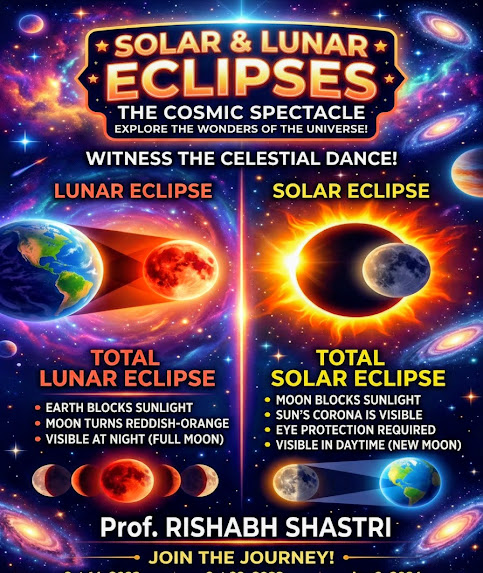
 SOLAR AND LUNAR ECLIPSE IN VEDIC ASTROLOGY
 SOLAR AND LUNAR ECLIPSE IN VEDIC ASTROLOGY
Astrologer Prof._RISHABH SHASTRI
#Astrologer_Palmist_Numerologist_Vastuvid_Gems
_Therapist_Author_and_Astro_Guru
In Vedic astrology (Jyotisha), an eclipse occurs when the Sun or Moon aligns closely with the lunar nodes (Rahu or Ketu). These nodes are considered as "Shadow Planets" or Chhaya Grahas; that temporarily "seize" or “swallow” the luminaries, causing a Grahan (Eclipse).
ASTRONOMICAL & ASTROLOGICAL TIMING
SOLAR ECLIPSE
Solar Eclipse (Surya Grahan) occurs only on a New Moon (Amavasya) when the Sun and Moon are in the same zodiac sign (conjunction) near Rahu or Ketu.
LUNAR ECLIPSE
Lunar Eclipse (Chandra Grahan) occurs only on a Full Moon (Purnima) when the Sun and Moon are in opposite zodiac signs (180 degrees apart) and aligned with the Rahu-Ketu axis.
DURATION (ORB OF INFLUENCE)
An eclipse typically happens when the luminaries are within roughly 12 to 18 degrees of the nodes.
VEDIC SIGNIFICANCE & RITUALS
Vedic astrology views eclipses as inauspicious for material pursuits but highly potent for spiritual growth.
SUTAK KAAL (impure or inauspicious Period)
A preparatory "impure" period that begins 12 hours before a solar eclipse and 9 hours before a lunar eclipse.
Activities Prohibited during eclipse
It is traditionally advised to avoid eating, sleeping, or starting new ventures during the eclipse to prevent negative karmic impact.
RECOMMENDED RITUALS AND PRACTICES
Chanting mantras (such as the Mahamrityunjaya Mantra), meditation, and charity are believed to yield amplified spiritual benefits during this time.
HOLY BATH (SNAN) FOR PURIFICATION
After the eclipse ends, individuals often take a ritual bath and clean their homes to remove the "shadowy" influence.
HOW TO CALCULATE ECLIPSE IN VEDIC ASTROLOGY (JYOTISHA)
Solar and Lunar eclipses are predicted by calculating the exact longitudinal positions of the Sun, Moon, and the Lunar nodes (Rahu and Ketu).
Modern calculations often follow the Surya Siddhanta or Drik Ganitham methods.
1. THE PROXIMITY RULE
An eclipse occurs when the luminaries are within a specific angular distance (orb) of Rahu or Ketu.
SOLAR ECLIPSE -- Sun and Moon must be in conjunction (Amavasya) and within 11 to 18 degrees of a lunar node.
LUNAR ECLIPSE --- Sun and Moon must be in opposition (Purnima) and within 8 to 13 degrees of the node axis.
2. MANUAL CALCULATION
Traditional astrologers use the Panchangam (five limbs) to track these movements. The core mathematical process involves -----
TITHI INDEXING
Calculating the "Tithi Index," which represents the angular distance between the Sun and Moon in 12-degree increments.
MEAN VS. TRUE LONGITUDE
Applying correction factors (like Mandaphala) to find the "True Longitude" of the planets, as their speeds are Non-Linear.
NODE TRACKING
Rahu and Ketu move retrograde, shifting back through one zodiac sign every 18 months.
3. USING SAROS & INEX CYCLES
Ancient seers identified cycles where eclipses repeat in similar patterns.
SAROS CYCLE
A period of approximately 18 years and 11 days used to predict the recurrence of similar eclipses.
MATHEMATICAL FORMULA
Some modern interpretations of ancient texts use a linear year correction.
 4. RELIABLE TOOLS FOR ADVANCE PLANNING
For non-mathematicians, the most accurate way to calculate eclipses years in advance is using Drik Panchangam or professional software like Jagannatha Hora. These tools integrate ancient Vedic algorithms with modern NASA EPHEMERIS data for high precision.
UPCOMING NOTABLE ECLIPSE
This year (2026), there are four major eclipse events.
1) Tuesday, March 3, 2026, a Total Lunar Eclipse is taking place.
2) August 12, 2026 (Total Solar Eclipse)
The "Great European Eclipse" will be visible as a total eclipse in Greenland, Iceland, and Northern Spain. In many other regions, including parts of North America and Europe, it will be seen as a partial solar eclipse.
3) August 28, 2026 (Partial Lunar Eclipse): This deep partial eclipse will be visible across the Americas, Europe, Africa, and Western Asia.
ECLIPSES IN 2027
February 6, 2027 (Annular Solar Eclipse): Visible in South America and Antarctica.
February 20–21, 2027 (Penumbral Lunar Eclipse): A subtle shading on the moon visible in much of Africa, Europe, and Asia.
August 2, 2027 (Total Solar Eclipse): One of the longest total solar eclipses of the century, passing over North Africa and the Middle East, with over 6 minutes of totality in Luxor, Egypt.
TODAY’S LUNAR ECLIPSE
Since the Moon rises while the eclipse is already in progress in India, only the final stages are visible at dusk.
SUTAK KAAL
Began at 06:23 AM IST and will end with the conclusion of the eclipse.
VISIBLE WINDOW
Best viewed between 06:33 PM and 06:40 PM IST looking toward the eastern horizon.
UPCOMING SOLAR AND LUNAR ECLIPSES FROM 2028 TO 2030 AD
Below is the schedule for solar and lunar eclipses from 2028 to 2030.
|
Year |
Date |
Eclipse Type |
Luminary |
Primary Visibility |
|
2028 |
Jan 12 |
Partial |
Lunar |
Americas, Europe, Africa |
|
Jan 26 |
Annular |
Solar |
South America, Spain, Portugal |
|
|
Jul 6 |
Partial |
Lunar |
Europe, Africa, Asia, Australia |
|
|
Jul 22 |
Total |
Solar |
Australia, New Zealand |
|
|
Dec 31 |
Total |
Lunar |
Europe, Africa, Asia, Australia |
|
|
2029 |
Jan 14 |
Partial |
Solar |
North & Central America |
|
Jun 12 |
Partial |
Solar |
Arctic, Scandinavia, Alaska |
|
|
Jun 26 |
Total |
Lunar |
Americas, Europe, Africa |
|
|
Jul 11 |
Partial |
Solar |
Southern Chile & Argentina |
|
|
Dec 5 |
Partial |
Solar |
Southern Argentina, Antarctica |
|
|
Dec 20 |
Total |
Lunar |
Americas, Europe, Africa, Asia |
|
|
2030 |
Jun 1 |
Annular |
Solar |
Europe, N. Africa, Middle East, Asia |
|
Jun 15 |
Partial |
Lunar |
Europe, Africa, Asia, Australia |
|
|
Nov 25 |
Total |
Solar |
Southern Africa, Australia |
|
|
Dec 9 |
Penumbral |
Lunar |
Americas, Europe, Africa, Asia |
ASTROLOGICAL INSIGHTS FOR THESE YEARS
The 2028 Total Solar Eclipse (July 22): This is a highly significant event in Vedic astrology as it occurs in the sign of Cancer (Karka Rashi). It is particularly powerful because it falls near the peak of the lunar node's influence on the water signs.
The 2029 "Quadruple" Solar Year: 2029 is unique because it features four partial solar eclipses in a single calendar year, which is the maximum possible, signalling a period of rapid social or political shifts according to traditional Vedic interpretations.
Lunar Tetrad Return: The back-to-back Total Lunar Eclipses (Blood Moons) in June and December 2029 are often viewed by spiritual practitioners as a "recharging" period for meditation and ancestral rituals (Tarpan)
With Warm Wishes and Sincere Regards
Astrologer Prof._RISHABH SHASTRI
#Astrologer_Palmist_Numerologist_Vastuvid_Gems_Therapist_Author_and_Astro_Guru
#ज्योतिषं #जीवनस्य #दर्पणम् /#अहर्निशं #धीमहि #ज्योतिषम् ।।
#जय #माँ #तारा /#सर्वेषाम् #मंगलम् #भवतु ।। -#अध्यापक #ऋषभ #शास्त्री